SAT Math Prep: The Only Algebra Guide You Need
SAT Math Prep: The Only Algebra Guide You Need
Here's the thing nobody tells you about SAT Math: you don't need to be a math genius to score 700+. You need to be a very reliable algebraist.
Algebra and its close relatives — linear equations, systems, functions, quadratics — account for somewhere between 60 and 70% of all math questions on the digital SAT. The rest is geometry, trigonometry, statistics, and probability. Those topics exist. They matter. But if your algebra foundation has cracks in it, everything built on top will collapse too.
This guide covers every algebra concept the SAT actually tests, how it tests them, and what to prioritize first. By the end, you'll know exactly where your time is worth spending.
How SAT Math is structured
The digital SAT Math section has two modules of 22 questions each, totaling 44 questions in 70 minutes. Questions are a mix of multiple choice (four options) and student-produced response (you type the answer — no options given).
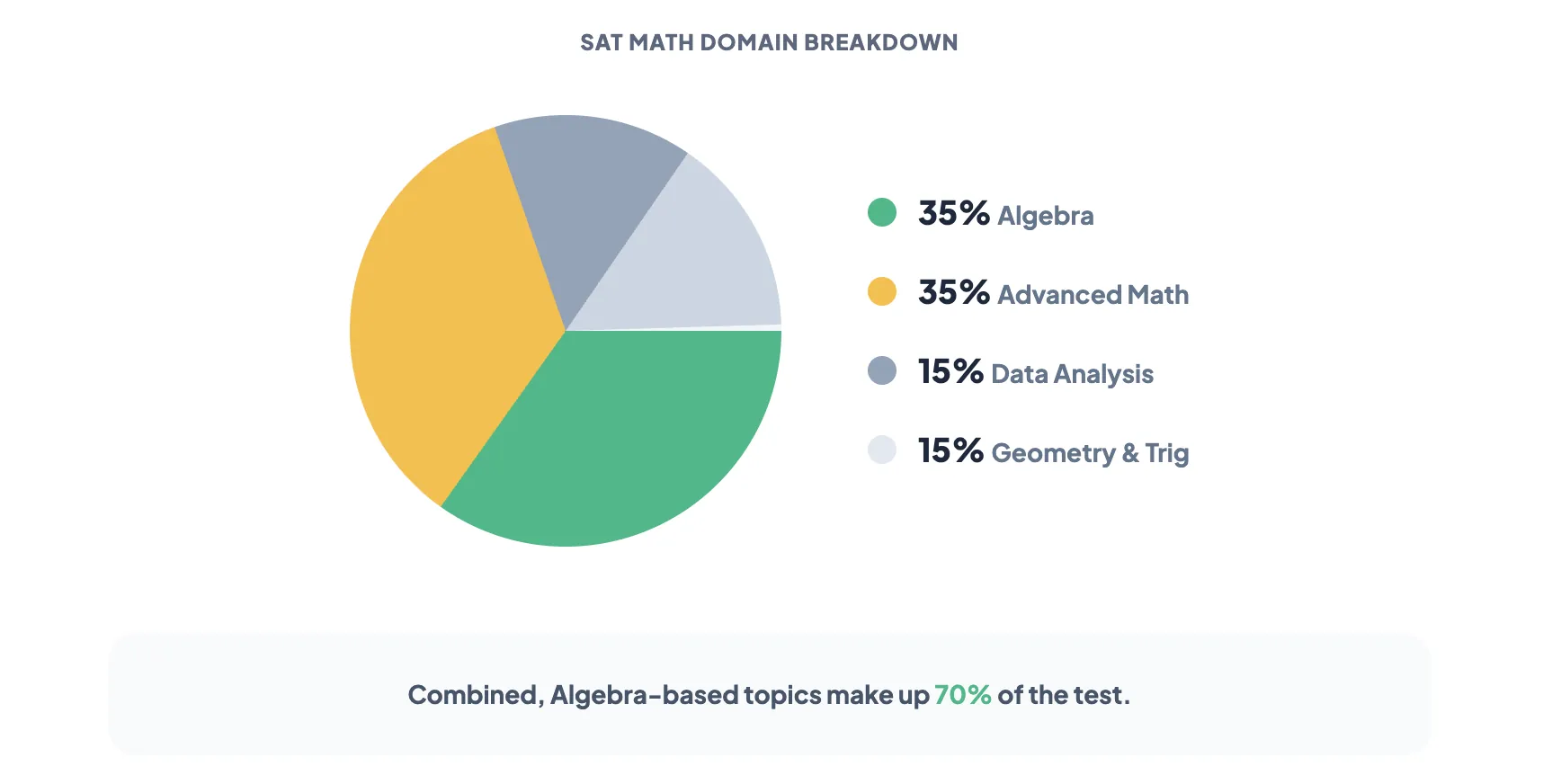
The College Board groups math content into four domains:
| Domain | Share of test | What it includes |
|---|---|---|
| Algebra | ~35% | Linear equations, inequalities, systems, graphs |
| Advanced Math | ~35% | Quadratics, polynomials, exponentials, functions |
| Problem Solving & Data Analysis | ~15% | Ratios, percentages, statistics, probability |
| Geometry & Trigonometry | ~15% | Area, volume, right triangles, circles, basic trig |
Notice that Algebra and Advanced Math together make up roughly 70% of the test — and Advanced Math is mostly quadratics and functions, which are extensions of algebra. If you treat these two domains as one unified block to master, you've already covered the vast majority of what's tested.
The non-negotiable foundation: linear equations
Everything in SAT algebra starts here. If you can't solve linear equations reliably and quickly, nothing else in this guide matters yet.
Single-variable linear equations
The SAT regularly presents equations that look messier than they are. The test loves disguising simple linear equations with fractions, nested parentheses, or variables on both sides.
Example type:
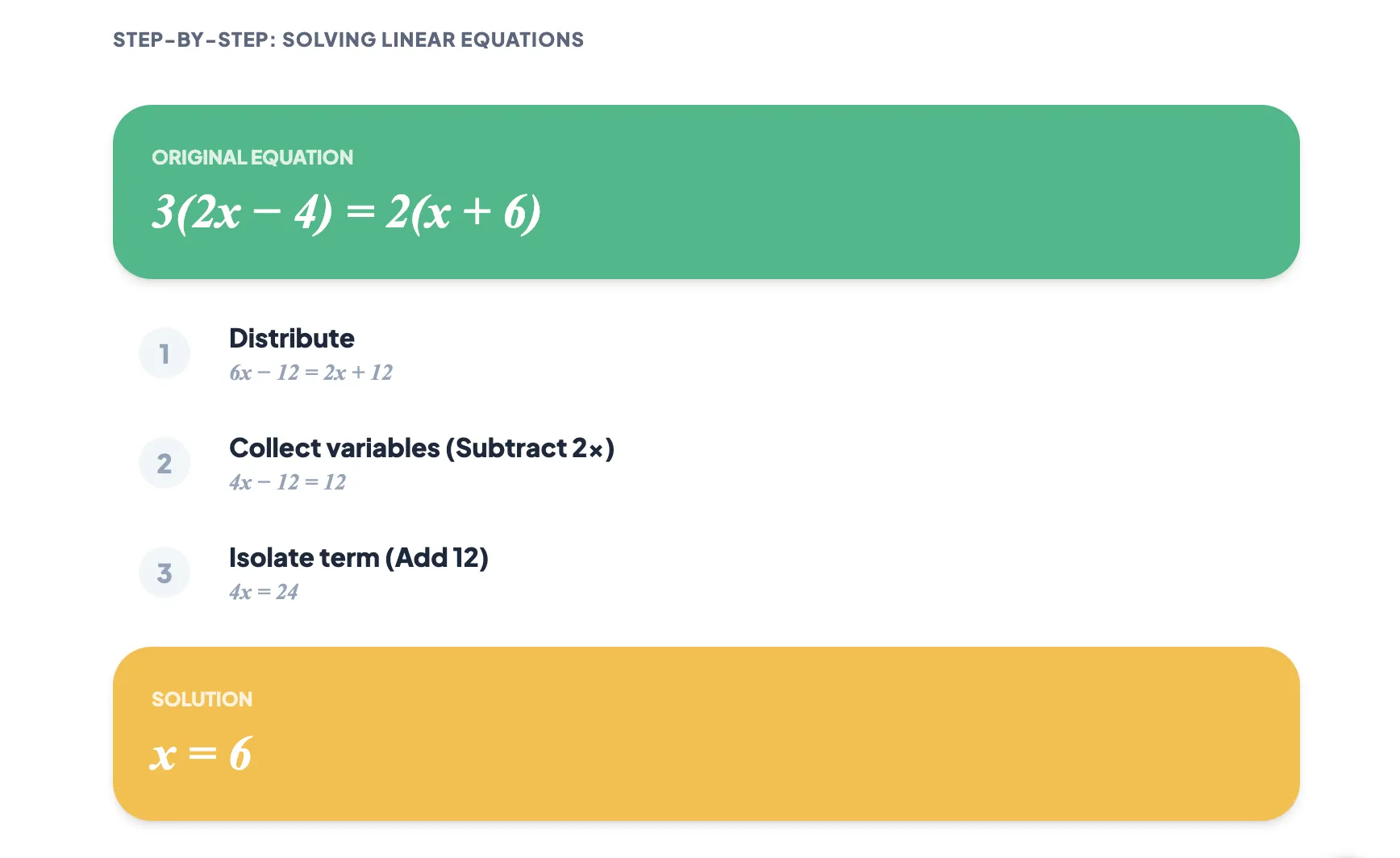
3(2x − 4) = 2(x + 6)
The skill being tested is not the arithmetic — it's recognizing that this is a one-step-at-a-time problem, not a complex one. Distribute, collect like terms, isolate x. That's it.
What the SAT actually cares about:
- Solving for x in one step vs. multiple steps
- Recognizing when an equation has no solution or infinitely many solutions
- Working with equations that contain fractions (multiply through by the denominator first)
Linear equations in two variables
These are equations of the form y = mx + b. The SAT tests your ability to:
- Identify the slope and y-intercept from an equation
- Write an equation from a graph or a described situation
- Understand what slope means in context (rate of change, not just a number)
- Find the x-intercept (set y = 0 and solve)
The most common mistake: confusing what the slope and intercept represent in a word problem. The SAT will describe a real-world situation and ask what the y-intercept means. The answer is always the starting value — what the quantity equals when the independent variable is zero.
Systems of linear equations
This is one of the highest-frequency topics on the entire test. Expect 3–5 questions per test that involve systems directly or indirectly.
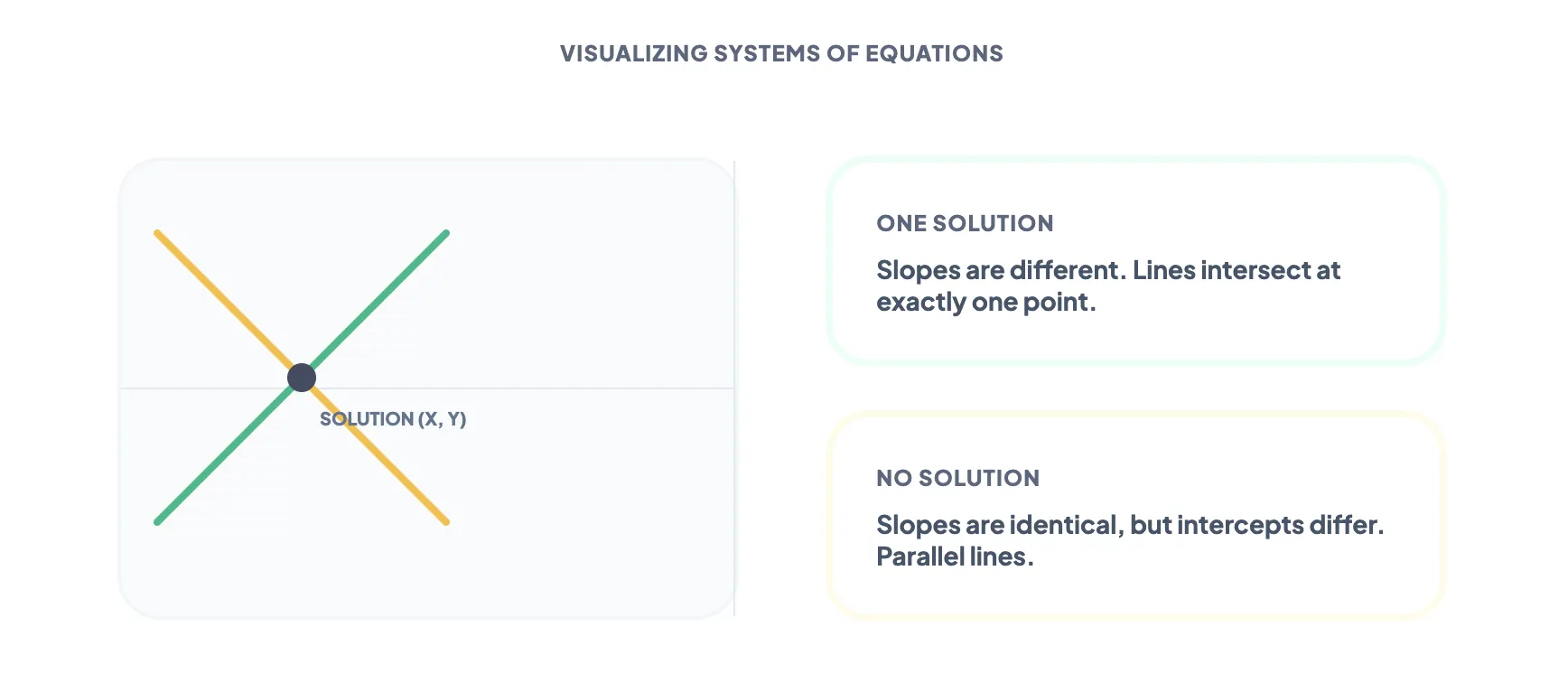
A system of two linear equations has three possible outcomes:
- One solution — the lines intersect at a point
- No solution — the lines are parallel (same slope, different intercepts)
- Infinitely many solutions — the lines are identical (same slope, same intercept)
The SAT loves asking about the conditions for no solution or infinitely many solutions — not just asking you to solve. Know the conditions cold:
- No solution: same slope, different y-intercept →
m₁ = m₂,b₁ ≠ b₂ - Infinite solutions: identical equations → multiply one equation by a constant and you get the other
Solving methods
Substitution — isolate one variable in one equation and plug into the other. Best when one variable is already isolated or easy to isolate.
Elimination — multiply one or both equations so that one variable cancels when you add them. Best when coefficients are easy to match.
Desmos — for multiple-choice questions, graph both equations and read the intersection. Takes 15 seconds. See post #4 for the full Desmos strategy.
Systems with three variables or substitution chains
The SAT occasionally presents problems that look like systems with three unknowns but are actually solvable with two equations through substitution. Don't be intimidated — identify what the question is actually asking for (often a combination like x + y, not x and y individually) and work backwards from there.
Linear inequalities
The rules are nearly identical to equations — with one critical difference: multiplying or dividing by a negative number flips the inequality sign.
The SAT tests this flip consistently and deliberately. It appears in pure algebra questions and in word problem contexts. Internalize it.
Types you'll encounter:
- Single inequalities: solve and express as a range
- Systems of inequalities: find the region that satisfies both (graph it)
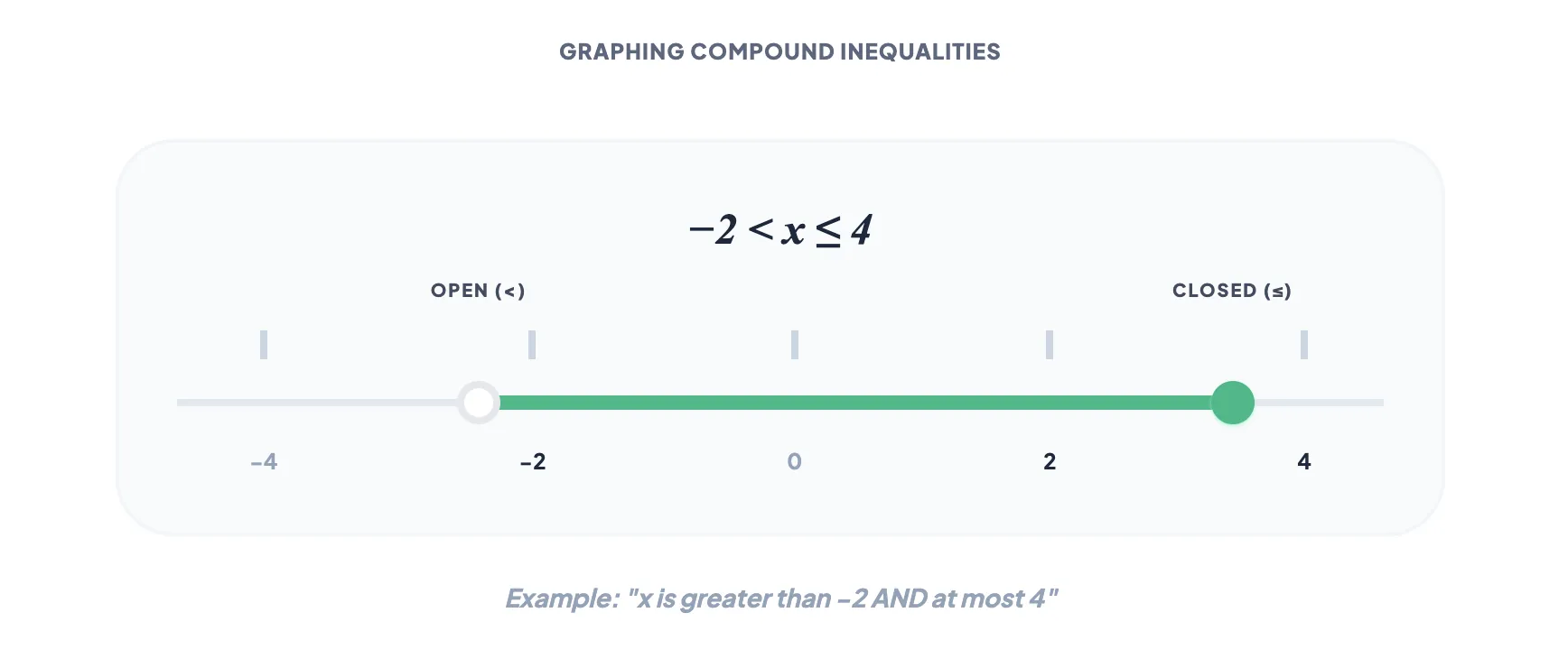
- Compound inequalities:
a < x < b— solve both parts simultaneously
Word problems involving inequalities typically describe constraints. "No more than," "at least," "a maximum of," "a minimum of" — each phrase maps to a specific inequality symbol. Memorize the mapping.
| Phrase | Symbol |
|---|---|
| At least / no less than | ≥ |
| At most / no more than | ≤ |
| More than / greater than | > |
| Less than / fewer than | < |
Quadratics and polynomials (Advanced Math)
Technically in the Advanced Math domain, but functionally an extension of algebra. You will see quadratics on every single SAT.
The three forms of a quadratic
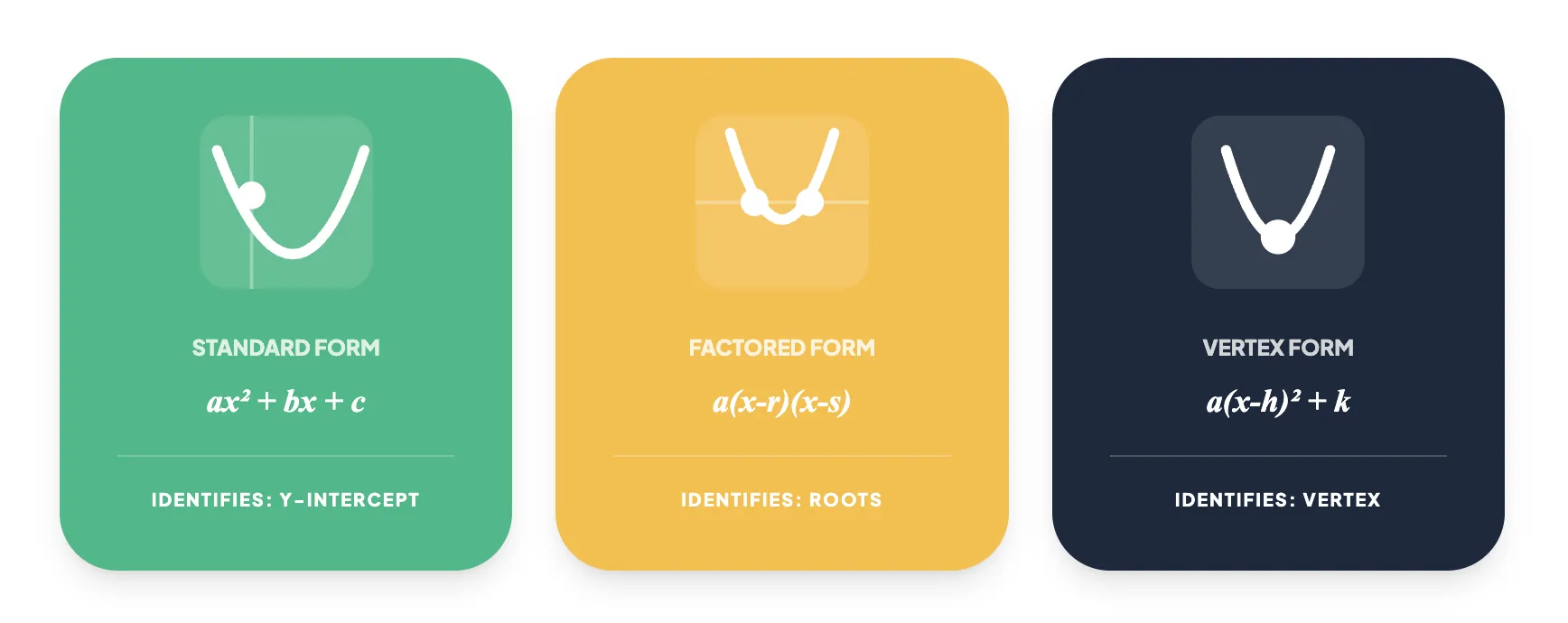
Every quadratic can be written in three ways, and the SAT exploits all three:
Standard form: y = ax² + bx + c
- c is the y-intercept
- Use the quadratic formula to find roots:
x = (−b ± √(b²−4ac)) / 2a
Factored form: y = a(x − r₁)(x − r₂)
- r₁ and r₂ are the x-intercepts (roots/zeros)
- Easiest form for reading solutions directly
Vertex form: y = a(x − h)² + k
- (h, k) is the vertex
- h is the axis of symmetry
- k is the minimum (if a > 0) or maximum (if a < 0) value
The SAT will give you one form and ask about a property best read from another. Fluency in converting between forms is essential.
The discriminant
The discriminant is b² − 4ac, the expression under the square root in the quadratic formula. It tells you how many real solutions exist:
b² − 4ac > 0→ two real solutionsb² − 4ac = 0→ one real solution (the vertex touches the x-axis)b² − 4ac < 0→ no real solutions
The SAT asks about the discriminant in two ways: directly ("how many solutions does this equation have?") and through graphs ("which graph shows a quadratic with no real solutions?").
Factoring
You need to be able to factor quadratics quickly. The SAT doesn't reward long quadratic formula calculations when factoring takes five seconds.
Key factoring patterns to memorize:
- Difference of squares:
a² − b² = (a + b)(a − b) - Perfect square trinomial:
a² + 2ab + b² = (a + b)² - Simple trinomials:
x² + bx + c = (x + p)(x + q)where p + q = b and p × q = c
Functions
Functions are algebra's way of expressing relationships between variables. The SAT tests functions heavily — both the notation and the conceptual understanding.
Function notation
f(x) = 3x + 2 means "plug x in, multiply by 3, add 2." The SAT will ask:
- What is f(4)? → plug in 4
- What is f(x + 1)? → plug in (x + 1) everywhere
- What is f(f(2))? → evaluate from the inside out
None of these are conceptually hard. They become errors when students rush and substitute incorrectly.
Transformations
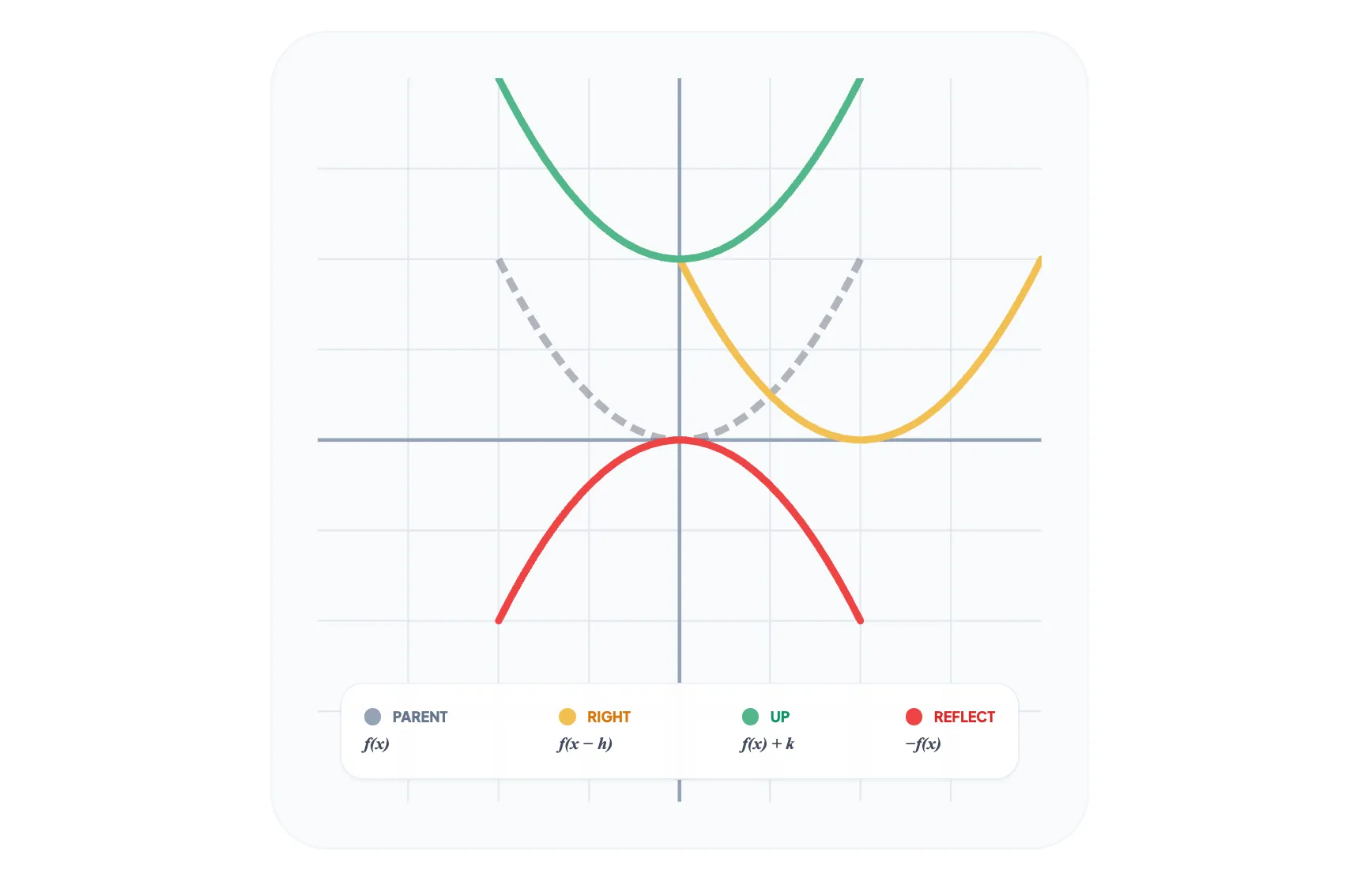
Given a base function f(x), the SAT asks how modifications change the graph:
| Transformation | Effect on graph |
|---|---|
f(x) + k | Shifts up by k |
f(x) − k | Shifts down by k |
f(x + h) | Shifts left by h |
f(x − h) | Shifts right by h |
−f(x) | Reflects over x-axis |
f(−x) | Reflects over y-axis |
a·f(x), a > 1 | Stretches vertically |
The most common mistake: f(x + h) shifts left, not right. The sign is counterintuitive. Memorize the direction with an example.
Linear vs. exponential growth
A recurring question type gives you a table of values and asks you to identify whether the relationship is linear or exponential — and then write the equation.
- Linear: constant difference between y-values →
y = mx + b - Exponential: constant ratio between y-values →
y = a · bˣ
Check the differences first. If they're constant, it's linear. If the differences aren't constant but the ratios are, it's exponential.
Ratios, percentages, and rates (Problem Solving & Data Analysis)
These don't feel like "algebra" but they use every algebraic skill you've built. The SAT frames them as word problems and tests whether you can translate English into equations.
Percentages
Three types of percentage questions appear repeatedly:
- Percent of a value:
part = (percent/100) × whole - Percent change:
(new − old) / old × 100 - Percent of percent: apply one percentage, then apply another to the result (not to the original)
The third type is where students lose points. "A price increases by 20%, then decreases by 20%" does not return to the original price. The decrease applies to the higher value.
Proportions and unit conversion
Set up proportions as fractions and cross-multiply. For unit conversion, chain conversion factors until the unwanted units cancel. These are mechanical skills — they just need practice until they're automatic.
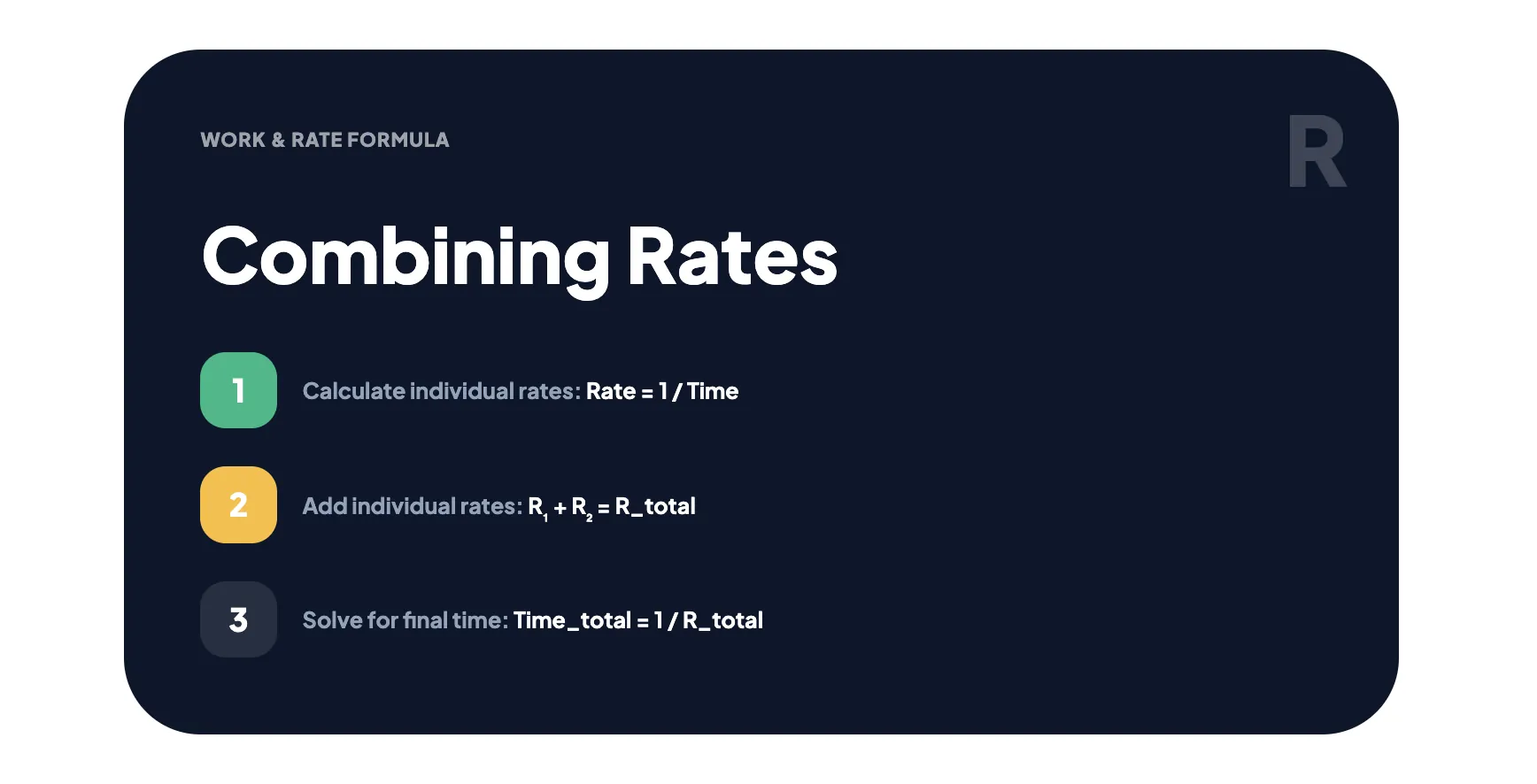
Rate problems
Distance = Rate × Time. Work problems use the same structure: work = rate × time. When two workers or two rates combine, add their rates (not their times).
What to study first: a priority order
Not all of these topics have equal weight on the test. Here's where to focus your time based on frequency and point value:
- Linear equations and systems — highest frequency, appears in both modules, foundational for everything else
- Quadratics — appears on every test, multiple question types, high difficulty ceiling
- Functions — appears in both algebra and advanced math contexts
- Linear inequalities — moderate frequency, very learnable rules
- Percentages and ratios — consistent 2–3 questions per test, word-problem format
- Exponential functions — moderate frequency, often tested via tables or graphs
- Geometry and trig — lowest priority if time is limited; real-world impact is smaller
If you have 4 weeks, spend the first two entirely on items 1–3. If you have 8 weeks, move through the full list.
The one tool that changes everything
The digital SAT provides a built-in Desmos graphing calculator for all math questions. Most students use it as a basic calculator. High scorers use it to sidestep algebra entirely on multiple-choice questions.
For nonlinear systems — the type that would take 3–4 minutes of substitution — graphing both equations and reading the intersection takes under 20 seconds. For quadratics, graphing instantly reveals the roots, vertex, and number of solutions without any formula.
We wrote a full guide to using Desmos strategically: How to use Desmos on the SAT: the complete cheat-code guide.
Putting it together with daily practice
Knowing these concepts is necessary. Getting them right under 95 seconds of time pressure per question is the actual skill — and that only comes from repeated, deliberate practice.
The most effective practice structure:
- Untimed first — work through new concept types without a clock until you understand the mechanics
- Timed second — drill the same types under module timing (22 questions, 35 minutes)
- Error log always — every wrong answer gets categorized: content gap, careless error, or pacing error. Each needs a different fix.
LockedIn delivers curated SAT math problems to your inbox daily — algebra-heavy, high-difficulty, with instant feedback. Free, no tutor, no $500 course. Just consistent reps on the problems that actually move your score.
Start for free at lockedin.study →
The short version
| Topic | Priority | Key thing to know |
|---|---|---|
| Linear equations | Critical | Recognize disguised forms, solve fluently |
| Systems of equations | Critical | Know the 3 outcome types, use Desmos on MC |
| Quadratics | Critical | Master all 3 forms and the discriminant |
| Functions | High | Notation, transformations, linear vs. exponential |
| Inequalities | High | Flip the sign when multiplying/dividing by negative |
| Percentages & ratios | Medium | Percent of percent ≠ double the percent |
| Geometry & trig | Lower | Study last — lowest ROI per hour |
Related: How to use Desmos on the SAT: the complete cheat-code guide Related: How to study for the SAT effectively: the no-BS blueprint Related: Digital SAT adaptive format explained: how to use it to your advantage
LockedIn is a nonprofit SAT prep platform — free forever, built for students who are serious about their score. Get started at lockedin.study.
Enjoyed the read?
Join 10,000+ students getting elite SAT drills every morning at 5:00 AM.