How to Study for the SAT Effectively: The No-BS Blueprint
How to Study for the SAT Effectively: The No-BS Blueprint
Most SAT prep advice is recycled garbage. Flashcard packs you'll never open. YouTube videos that recap the same five tips. Courses that cost $500 and deliver a PDF.
This is not that.
This is what actually moves the needle — built on how the modern digital SAT works, what top scorers do differently, and how consistency beats cramming every single time.
First: Understand What You're Actually Studying For
The SAT changed. Fully digital since 2024, it now uses an adaptive format — meaning your score isn't just about right or wrong answers. It's about which questions you're getting right.
Here's how the adaptive engine works:
- The test has two sections: Reading & Writing and Math
- Each section has two modules
- Your performance in Module 1 determines the difficulty of Module 2
- A harder Module 2 = higher score ceiling. An easier Module 2 = capped potential
The implication: Getting 70–80% correct in Module 1 is more important than saving energy for the end. Students who coast through Module 1 often lock themselves out of the top score range before they realize it.
Step 1: Diagnose Before You Study
The single most common mistake in SAT prep is studying without a baseline.
Before you touch a flashcard or a math sheet, take a full-length official practice test under real timed conditions. Use the College Board's Bluebook app — it's the only tool that accurately simulates the adaptive algorithm, the interface, and the exact timing of the real test.
After the test:
- Record your total score and section scores separately
- Look up the middle 50% SAT ranges for your target colleges
- Set a specific point gap to close (e.g., "I need +160 in Math and +80 in R&W")
A target without a baseline is just optimism. A baseline without a target is just data. You need both.
Step 2: Build Your Study Plan Around Weaknesses — Not Comfort
Everyone defaults to practicing what they're already good at. It feels productive. It isn't.
After your diagnostic, categorize every mistake into one of three buckets:
- Content weakness — You got it wrong because you don't know the concept
- Careless error — You knew it but missed a word like "except," "least," or "not"
- Pacing error — You ran out of time or rushed the final third
Each bucket needs a different fix. Mixing them up (e.g., drilling more problems when the issue is pacing) wastes weeks.
Step 3: Master Math from the Ground Up
Algebra and arithmetic account for 60–70% of SAT Math. Not geometry. Not trigonometry. The fundamentals. If your algebra is shaky, no amount of advanced problem-solving will compensate.
Study priority order:
- Linear equations and systems of equations
- Quadratics and polynomials
- Ratios, percentages, and unit conversions
- Functions and graphs
- Statistics and data interpretation
- Geometry and trigonometry (last — lowest ROI for most students)
The Desmos Advantage
The digital SAT provides a built-in Desmos graphing calculator. Most students use it like a basic calculator. High scorers use it as a cheat code.
For nonlinear systems — the type that would take 3–4 minutes of algebraic substitution — graphing both equations in Desmos and reading the intersection takes under 20 seconds. Practice this until it's reflex.
Estimate First, Compute Second
For multiple-choice math questions, approximation is underutilized. Plug in rough numbers, eliminate two or three obviously wrong answers, then do the precise calculation only if needed. On questions where the answers are spread far apart, estimation alone can close the problem.
Step 4: Read Smarter, Not Harder
SAT Reading & Writing is not a reading test. It's a reasoning test using short passages.
The passages are short (25–150 words). Every question is answerable entirely from the text. There are no trick questions that require outside knowledge. The challenge is precision — finding the one answer that is fully supported by the passage, and eliminating the three that aren't.
Core skills to build:
Evidence-based reasoning. Every answer choice is either directly supported by the passage or it isn't. Train yourself to point to a specific sentence before selecting an answer. If you can't, it's wrong.
Standard English conventions. Punctuation and grammar questions follow strict, learnable rules: semicolons connect two independent clauses, colons introduce a list or explanation, dashes set off non-essential information. These are some of the most mechanical questions on the test — the highest ROI for quick score gains.
Words in context. The vocabulary questions don't test obscure definitions. They test whether you can identify the exact tone and function of a word in a specific sentence. Read the sentence with each answer choice substituted in. The right answer fits the tone perfectly.
The blurb matters. The short paragraph before each passage isn't filler. It tells you the author's purpose, the context, and often the tone — all of which help you evaluate answer choices before you've read a word of the actual passage.
Step 5: Practice Under Real Conditions
Untimed studying builds knowledge. Timed, full-length practice tests build the skill of using that knowledge under pressure. You need both — but most students only do one.
Run a full practice test every 1–2 weeks using Bluebook. Then spend at least as long reviewing the test as you spent taking it.
For every wrong answer, go through:
- What did I think the answer was, and why?
- What is the actual answer, and what does the explanation say?
- What pattern does this belong to?
- What will I do differently next time?
Keep an error log — a simple document or spreadsheet where you record every miss, its category (content / careless / pacing), and the pattern it represents. After 3–4 practice tests, you'll see the same 5–7 patterns repeating. Those patterns are your real study list.
Step 6: Use In-Test Strategy — Not Just Knowledge
Getting questions right on a practice set and getting questions right under test conditions are different skills.
Two-pass method. In each module, do a first pass where you answer everything you can do quickly and flag anything that will slow you down. Do a second pass on the flagged questions with remaining time. This guarantees that easy questions don't get skipped because you burned time on a hard one early.
Never leave a blank. There is no penalty for wrong answers on the digital SAT. A random guess has a 25% chance of being right. A blank has a 0% chance. This math is simple — always guess.
Process of elimination. When you don't know the right answer, find the wrong answers. Every incorrect choice is incorrect for a specific, identifiable reason. Ruling out two options turns a 25% guess into a 50% educated guess.
The Consistency Edge
Here's the secret that most students overlook: the students who improve the most aren't the ones who study the hardest in a single burst. They're the ones who show up every single day.
A 20-minute daily drill — one where you're fully focused, not half-distracted — beats a 3-hour Saturday session done with a phone next to you. Cognitive science is clear on this: spaced repetition (reviewing material over time) outperforms mass practice in both retention and transfer.
This is exactly why LockedIn was built the way it was.
Why LockedIn Exists
LockedIn is a completely free, nonprofit SAT prep platform built by SAT takers who were frustrated with expensive courses and low-signal content.
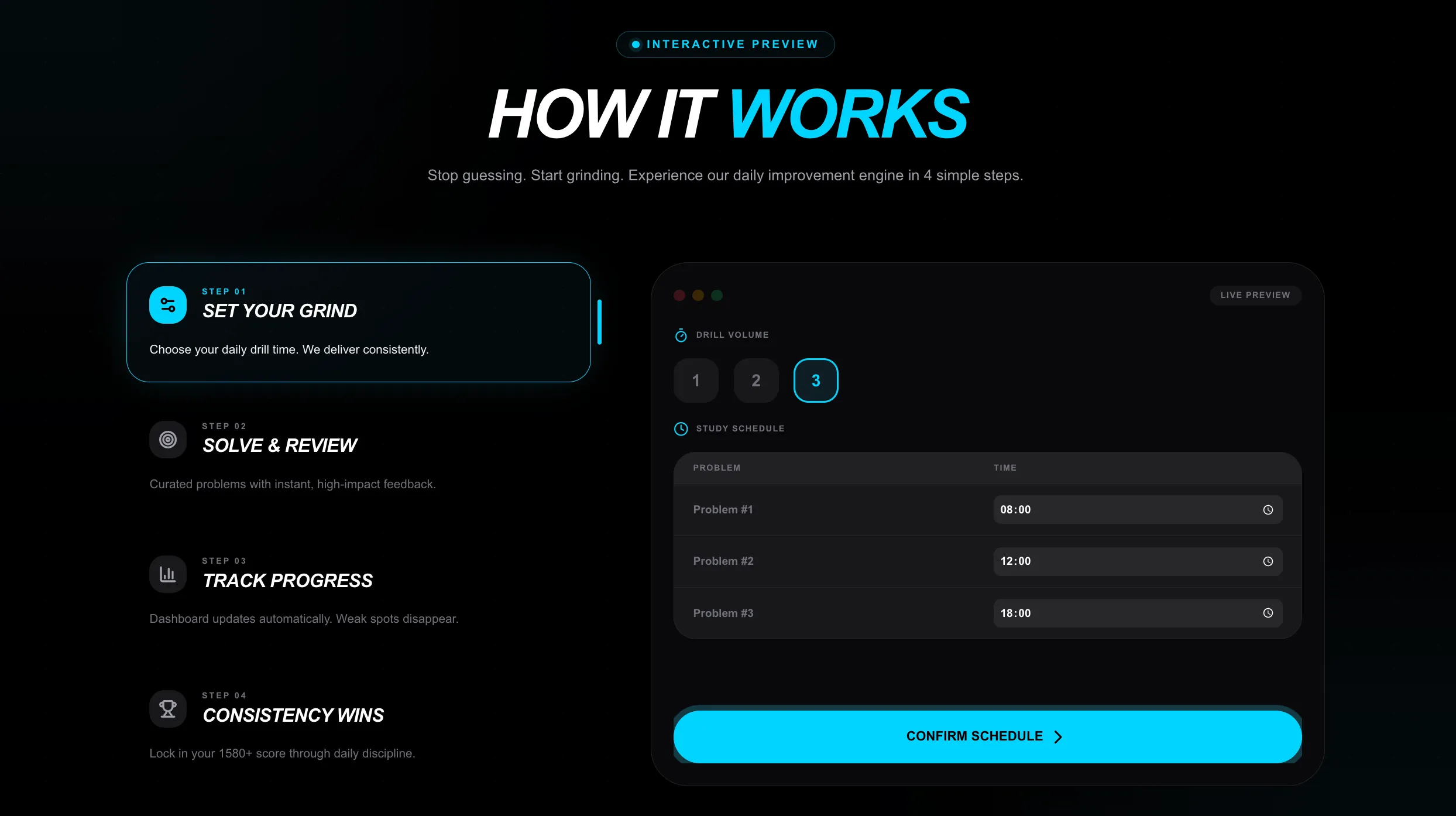
Here's how it works:
- Subscribe — sign up for free, no credit card, no trial period
- Set your schedule — choose how many problems you want and when you want them delivered
- Solve daily drills — curated, high-intensity problems delivered straight to your inbox
- Track your progress — your dashboard automatically updates and surfaces weak spots
No doomscrolling. No filler. Just elite-level problems, consistently, on your schedule.
SAT prep has always been pay-to-play. LockedIn is here to change that.
Start for free at lockedin.study →
The Short Version
| What to do | Why it works |
|---|---|
| Take a full Bluebook practice test first | Gives you a real baseline to work from |
| Target Module 1 accuracy above all else | Unlocks the high-difficulty module = higher ceiling |
| Fix algebra before anything else in Math | 60–70% of Math is built on fundamentals |
| Use Desmos graphically, not just as a calculator | Cuts solve time on nonlinear questions from minutes to seconds |
| Point to a sentence before picking an R&W answer | Forces evidence-based reasoning, eliminates guessing |
| Learn punctuation rules cold | Highest ROI per hour of study time |
| Two-pass method every module | Prevents easy questions from being skipped |
| Never leave a blank | No wrong-answer penalty — always guess |
| Keep an error log | Reveals the 5–7 patterns that are actually costing you points |
| Show up daily | Consistency beats intensity every time |
LockedIn is a nonprofit SAT prep platform — free forever, built for students who are serious about their score. Get started at lockedin.study.
Enjoyed the read?
Join 10,000+ students getting elite SAT drills every morning at 5:00 AM.