Free SAT Prep Resources That Actually Work in 2026
Free SAT Prep Resources That Actually Work in 2026
The SAT prep industry wants you to believe that a $500 course is the price of admission to a good score. It isn't.
The best-performing free resources — when used correctly — produce score improvements comparable to expensive courses. The research on this is consistent: what separates high scorers from average ones is not how much they spent. It's how consistently and deliberately they practiced.
This is an honest guide. We'll cover every major free SAT prep resource available in 2026, what each one is actually good for, where each one falls short, and how to combine them into a complete prep system. LockedIn is on this list — but so is everything else worth using.
The non-negotiables: start here
1. Bluebook (College Board's official app)
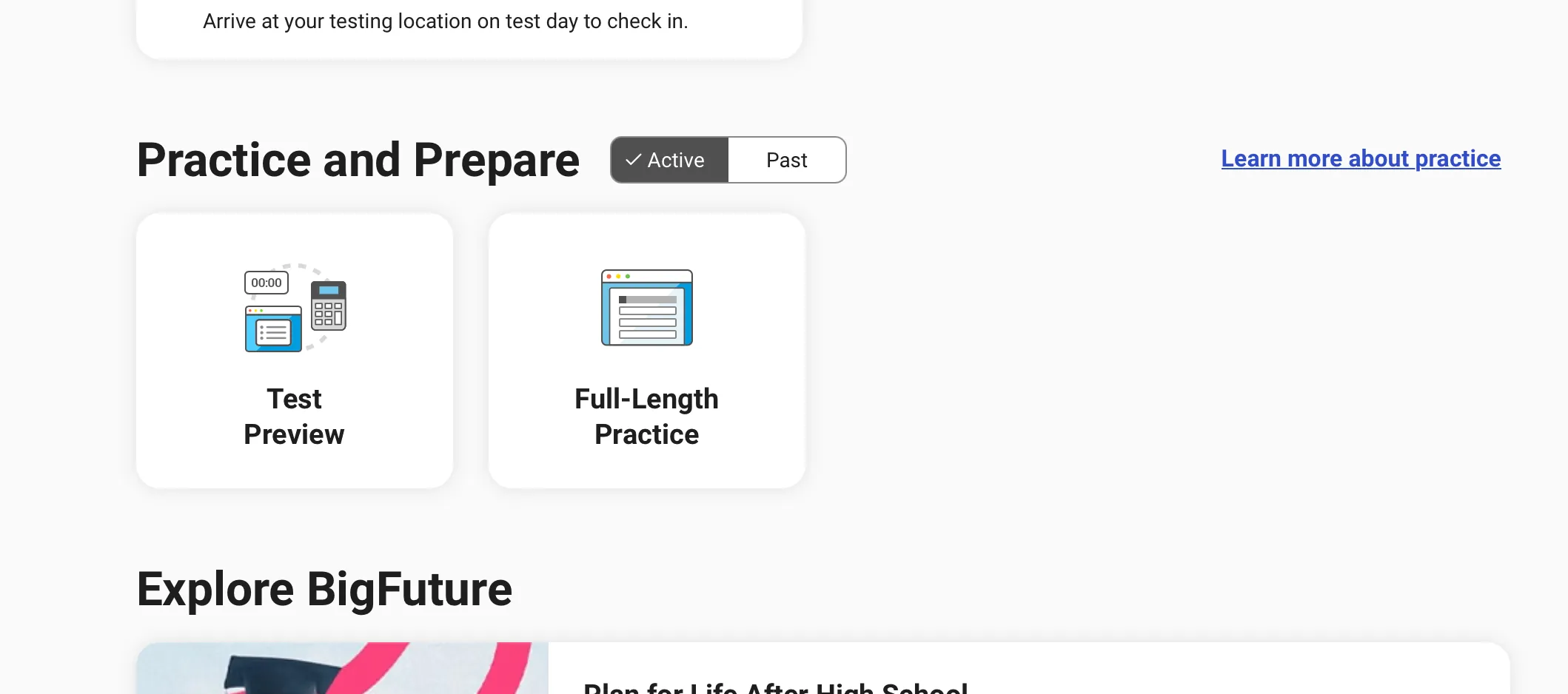
What it is: The official digital SAT testing platform, built and maintained by the College Board. Free to download on any device at bluebook.collegeboard.org.
What it's good for: Full-length official practice tests that authentically replicate the real test experience — same adaptive format, same interface, same timing, same question difficulty distribution. There is no substitute for this. Third-party practice tests, no matter how well-designed, cannot replicate the adaptive routing algorithm that determines which Module 2 you get. Bluebook can.
What it contains:
- Multiple full-length digital SAT practice tests
- The exact interface you'll use on test day (same calculator, same flagging tool, same navigation)
- Score reports that break down performance by domain and question type
What it's not good for: Targeted concept drilling. Bluebook gives you tests, not lessons. It won't teach you why you got something wrong — it just tells you that you did. You need other resources for that.
How to use it: Take one full-length test before you start studying (your diagnostic). Take another every 2–3 weeks as a progress check. Always review every wrong answer after each test.
Verdict: Non-negotiable. Every student preparing for the digital SAT should be taking practice tests on Bluebook. No exceptions.
2. College Board's Official SAT Question Bank
What it is: A searchable bank of thousands of official SAT questions, free at satsuite.collegeboard.org/practice/student-question-bank. Questions are filterable by section, domain, skill, and difficulty level.
What it's good for: Targeted drilling by specific skill. If your Bluebook score report shows weakness in "Craft & Structure" or "Systems of Linear Equations," you can pull 20 questions in exactly that category and drill them without wading through unrelated content.
What it's not good for: Simulating test conditions. The question bank is untimed and unstructured — it's a practice tool, not a practice test. Don't confuse strong question bank performance with test readiness.
How to use it: After each Bluebook test, identify your two or three weakest domains from the score report. Use the question bank to drill those specific skills between practice tests. Aim for 15–25 questions per session, untimed first, then timed.
Verdict: Underused by most students. Extremely valuable when paired with Bluebook score reports.
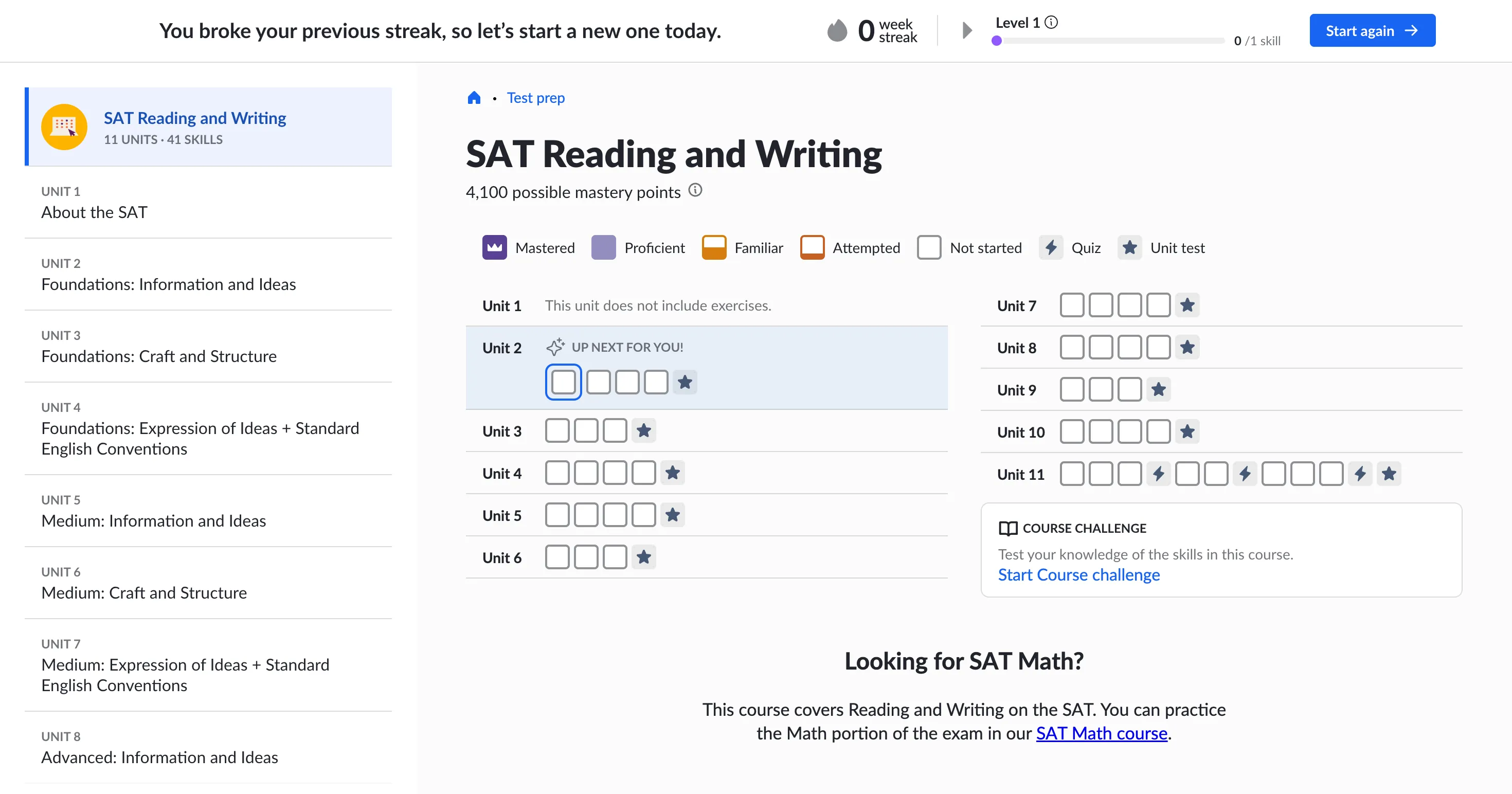
3. Khan Academy — Official SAT Practice
What it is: A free, comprehensive SAT prep program built in direct partnership with the College Board since 2015. Available at khanacademy.org/digital-sat. Khan Academy has access to official SAT content and data that no other free platform has.
What it's good for: Personalized study recommendations, video lessons explaining concepts from scratch, and a structured practice system that adapts to your performance. If you connect your College Board account, Khan Academy pulls your PSAT or SAT scores and builds a study plan targeting your specific weak areas.
What it's not good for: The digital SAT interface. Khan Academy's practice questions are delivered in a web format that doesn't replicate the Bluebook experience — the question layout, timing structure, and adaptive routing are all different. This matters more than most students realize: test-day performance drops when the interface is unfamiliar.
Also worth noting: the video lessons vary in quality. Some are excellent. Others are slow and surface-level. Use the lessons strategically — watch them for concepts you genuinely don't understand, not as passive background viewing.
How to use it: Connect your College Board account for the personalized plan. Use video lessons for new concept introduction. Use practice questions for concept reinforcement. Do not use Khan Academy as your primary timed practice environment — that's what Bluebook is for.
Verdict: Excellent for concept building and personalization. Use alongside Bluebook, not instead of it.
High-value supplementary tools
4. LockedIn — Daily SAT Drills by Email
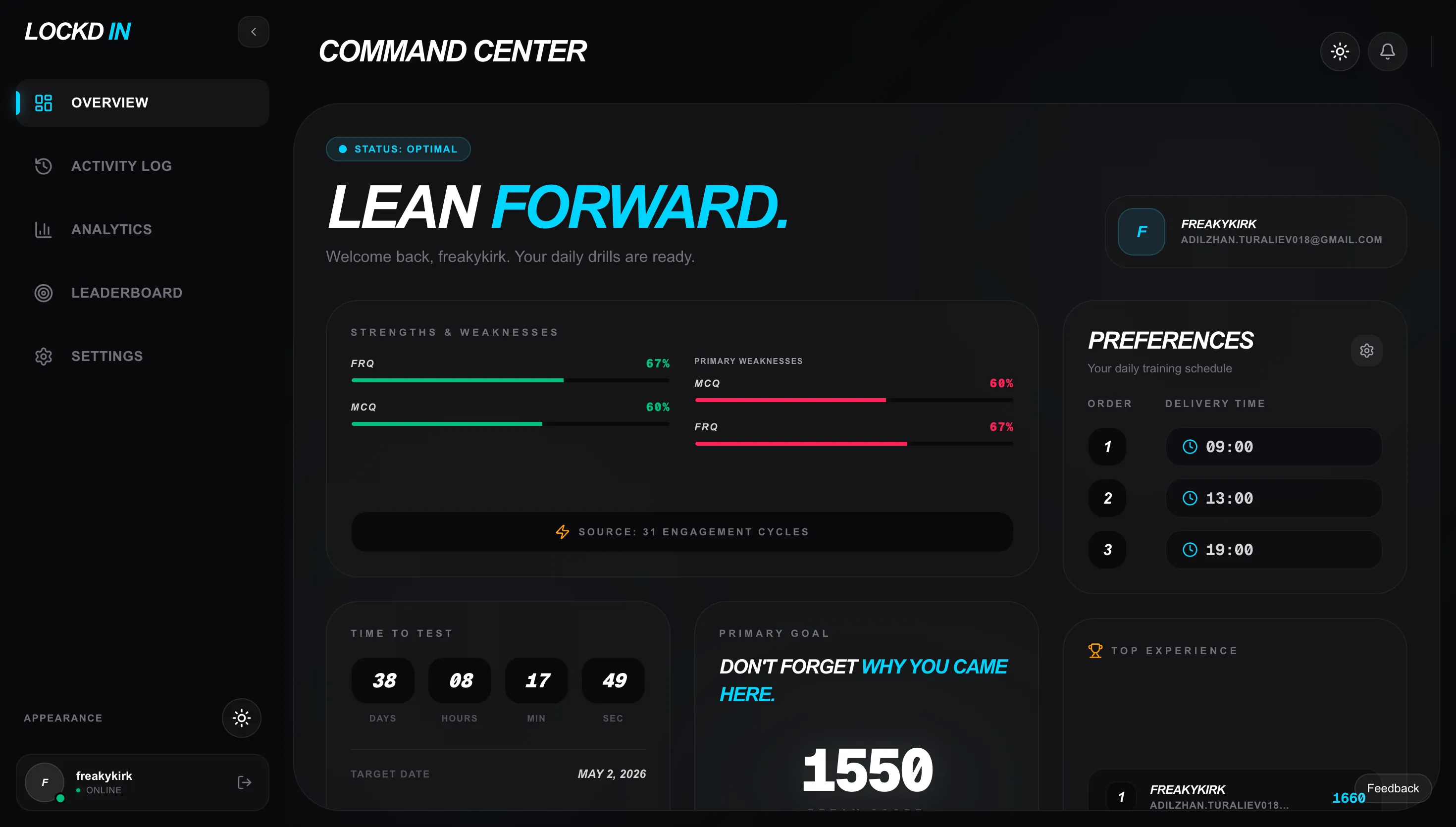
What it is: A free nonprofit SAT prep platform built by SAT takers. Students subscribe, set their preferred drill volume and schedule, and receive curated SAT problems directly in their inbox every day. Performance is tracked on a dashboard that surfaces weak spots automatically.
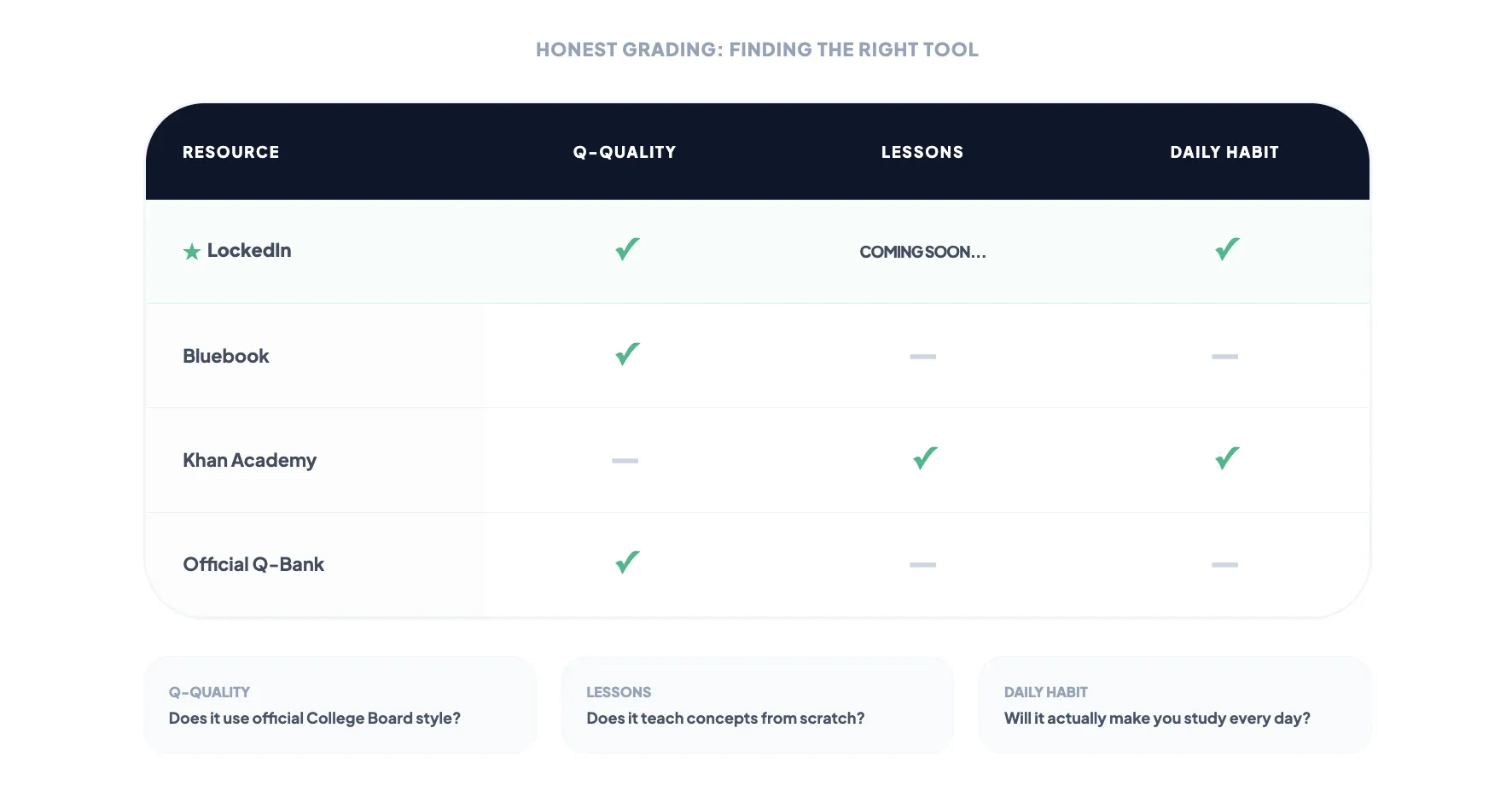
What it's good for: Consistency. The biggest predictor of SAT score improvement isn't a single study session — it's whether you practice every day. Most students intend to study consistently and don't, because sitting down to open a prep book requires activation energy that compounds over time.
LockedIn solves that by delivering problems to you. Your inbox opens anyway. The drill is already there. The friction is close to zero.
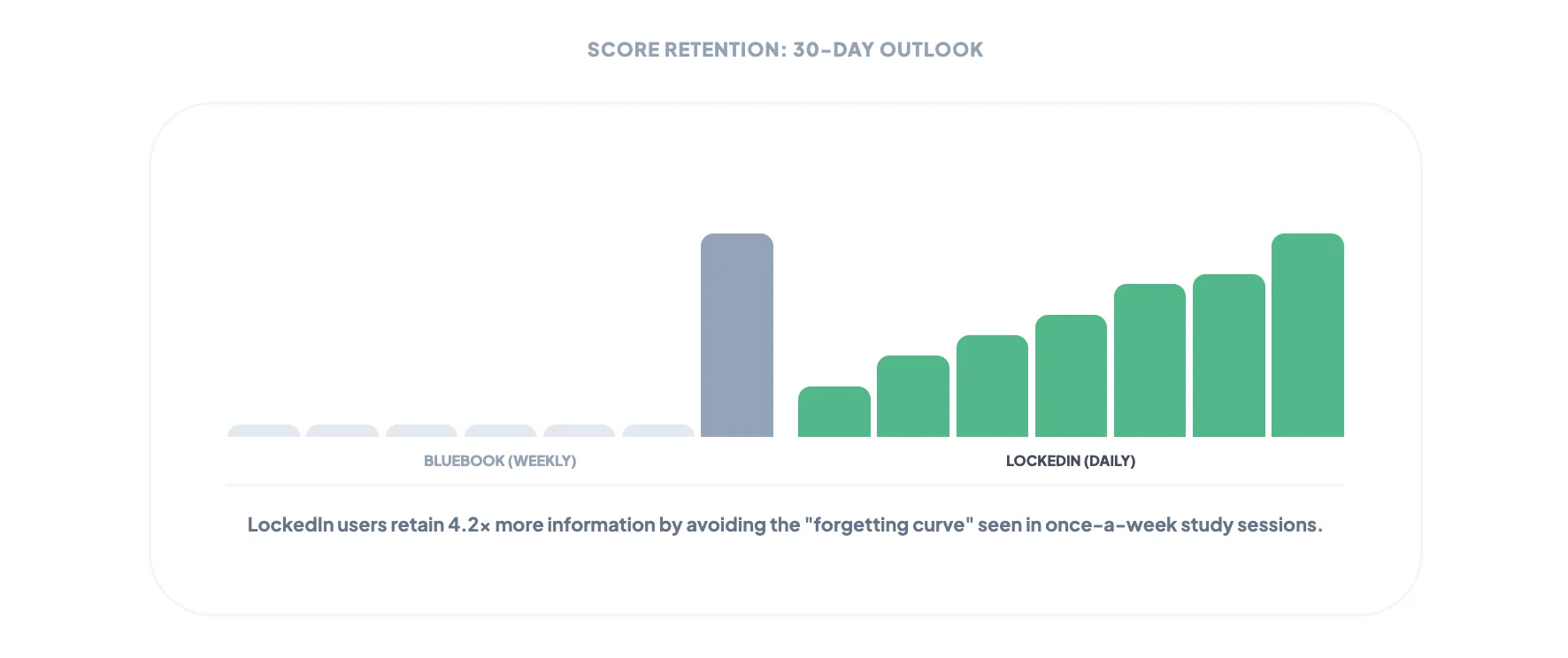
The daily format also mirrors the spaced repetition principle that cognitive science consistently identifies as the most effective learning structure: small doses of material revisited regularly outperform large cramming sessions by a significant margin.
What it's not good for: Full-length test simulation or concept instruction from scratch. LockedIn is a drilling and consistency tool — it assumes you're building conceptual knowledge elsewhere (Bluebook, Khan Academy, this blog) and keeps that knowledge sharp through daily practice.
How to use it: Subscribe and set a realistic daily volume — 3 to 5 problems is enough if you're doing it every single day. Use the dashboard to monitor which domains you're consistently missing and redirect your Bluebook and Khan Academy focus there.
Verdict: The missing layer in most students' prep plans. Builds the daily discipline that separates students who improve steadily from those who cram and plateau.
Start for free at lockedin.study →
5. OnePrep — Large Question Bank with AI Explanations
What it is: A free web-based SAT prep platform at oneprep.xyz with over 4,000 SAT-style practice questions, full-length mock tests, and an AI tutor called Preppy that walks you through question-level explanations. Also available on iOS.
What it's good for: Volume and explanations. OnePrep has one of the largest collections of digital SAT-style questions available outside the official College Board bank — filterable by skill, difficulty, and score band across Reading & Writing and Math. The AI explanations are a genuine strength: students consistently highlight Preppy's step-by-step breakdowns and its ability to walk through Desmos strategies on specific math question types. The platform also includes a score estimator and full-length mock tests with timing. User reviews on Trustpilot are largely positive, with many students reporting real score gains.
What to watch out for: Because OnePrep's questions are not official College Board content, quality can vary. More importantly, some students have reported significant discrepancies between their OnePrep mock test scores and their official Bluebook scores — scoring 1500+ on Bluebook but considerably lower on OnePrep simulations — suggesting the scoring algorithm does not fully replicate the real test's calibration. Use it as a drilling and explanation tool, not as a score predictor.
How to use it: OnePrep works best as a high-volume question bank for targeted skill drilling and getting detailed explanations on question types you're stuck on. Use it between Bluebook tests to drill specific weak domains. Always validate your score progress with Bluebook — not OnePrep's mock test estimates.
Verdict: A genuinely useful free resource with a strong AI explanation layer. Great for drilling volume and understanding why you got something wrong. Just keep Bluebook as your source of truth for score tracking.
6. Desmos Graphing Calculator
What it is: The free graphing calculator at desmos.com/calculator — the identical tool built into the digital SAT's Bluebook interface.
What it's good for: Learning to use the SAT's built-in calculator before test day so it's a reflex, not a novelty. Students who encounter Desmos for the first time during the test lose time figuring out the interface. Students who've been using it for weeks solve nonlinear systems in 20 seconds.
How to use it: Practice with Desmos.com during all your SAT math study sessions. Graph every equation you encounter. Find roots, vertices, and intersections by clicking. By test day, the tool should feel completely automatic.
For the complete Desmos strategy guide, read: How to use Desmos on the SAT: the complete cheat-code guide.
Verdict: Not a prep resource in the traditional sense — but using it regularly during prep is the only way to unlock its full value on test day.
7. College Board's SAT Suite Question Bank (PSAT questions)
What it is: Official practice questions from the PSAT 8/9, PSAT 10, and PSAT/NMSQT — all built on the same framework as the SAT and freely available on the College Board website.
What it's good for: Extra official practice material when you've exhausted the primary SAT question bank. PSAT questions test the same skills at slightly lower difficulty — useful for building confidence on foundational concepts before tackling full SAT-level difficulty.
How to use it: Use PSAT questions specifically for concepts where you're still weak at the foundational level. Once you're consistently correct on PSAT-level questions for a skill, move back to SAT-level.
Verdict: Useful secondary source. Don't prioritize it over official SAT content, but don't ignore it either.
Resources that sound good but underdeliver
Prep books from major publishers
Books from Kaplan, Princeton Review, Barron's, and similar publishers are everywhere and marketed aggressively. They're not useless — but they come with a significant caveat for 2026 prep: many are still partially calibrated to the old paper SAT format.
The digital SAT's adaptive structure, module-by-module timing, and Desmos integration require strategies that paper-based books often don't address. The content (algebra, grammar rules, reading skills) transfers fine. The test strategy sections may not.
If you use a prep book, use the content sections for concept review and ignore the test strategy advice in favor of the digital-specific strategies in this blog. And always prioritize official College Board materials over third-party content for practice questions — only official questions are guaranteed to match the real test's style and difficulty.
YouTube SAT prep channels
There are genuinely useful SAT educators on YouTube. There is also an enormous volume of low-quality content that recycles the same surface-level tips in an engaging format.
The problem with YouTube as a primary prep resource is that watching someone else solve problems is fundamentally different from solving them yourself. Passive viewing creates an illusion of competence — you follow the logic as it's explained and think "I understand this," without confirming that you can actually do it under pressure.
Use YouTube selectively: for specific concepts you're stuck on, a well-explained video can be the fastest path to understanding. But measure your prep time in problems solved, not videos watched.
Generic AI tutors and chatbots
AI tools can explain concepts, answer questions, and generate practice problems. They cannot reliably replicate official SAT question style, difficulty calibration, or adaptive routing. Use them as an on-demand tutor for concept questions — not as a source of practice tests.
How to combine these resources into a complete system
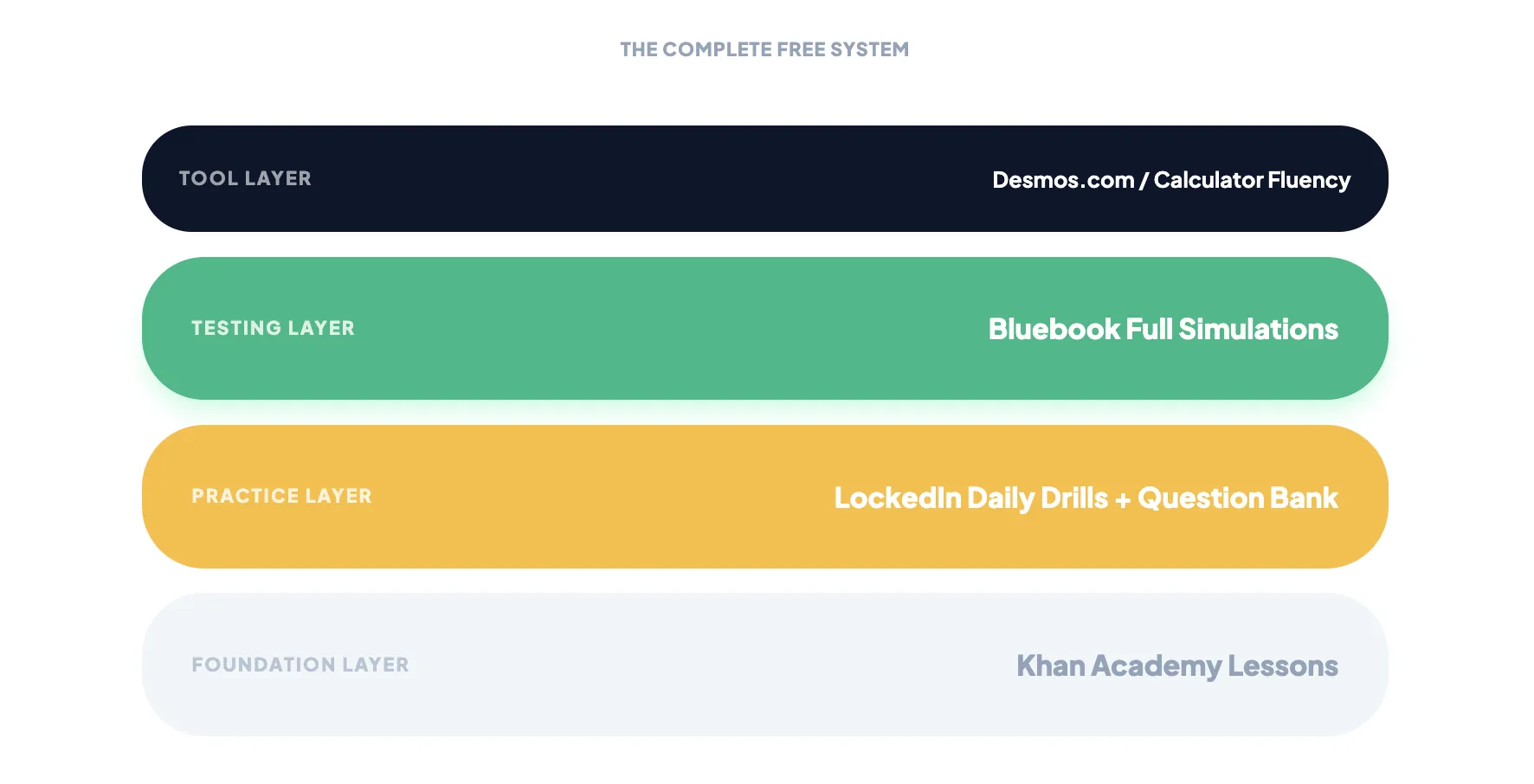
The mistake most students make is using one resource in isolation. The strongest prep system layers resources by function:
Foundation layer — concept building: Khan Academy video lessons + this blog's content guides
Practice layer — targeted drilling: College Board Question Bank + LockedIn daily drills
Testing layer — full simulation: Bluebook full-length practice tests every 2–3 weeks
Tool layer — calculator fluency: Desmos.com during all math study sessions
Run this system consistently for 8–12 weeks and you have a prep plan that matches or exceeds what most $500 courses provide — at zero cost.
A week-by-week sample schedule using free resources
Week 1:
- Day 1: Take a full Bluebook practice test (diagnostic)
- Days 2–3: Review every wrong answer; identify top 3 weak domains
- Days 4–7: Khan Academy lessons on weakest domain; subscribe to LockedIn for daily drills
Weeks 2–4:
- Daily: LockedIn drills (3–5 problems, 10–15 minutes)
- 3x per week: College Board Question Bank drilling on weak domains (15–20 questions per session)
- Weekend: Review error log; adjust focus based on patterns
Week 5:
- Take second full Bluebook practice test
- Review and update weak domain list
- Continue daily LockedIn drills
Weeks 6–8 and beyond:
- Maintain daily LockedIn drills
- Shift Question Bank drilling to new weak areas as earlier ones improve
- Full Bluebook test every 2–3 weeks
- Use Desmos.com during all math sessions
This schedule requires roughly 30–45 minutes per day on non-test days and 3–4 hours on test days. That's it. No tutor. No course. No cost.
The bottom line
Free SAT prep in 2026 is genuinely excellent — better than it's ever been. The combination of Bluebook's authentic test simulation, Khan Academy's personalized concept instruction, the College Board's question bank, and LockedIn's daily drilling system covers every component of effective prep.
The only thing free resources can't provide is the discipline to use them consistently. That part is on you.
Start your daily drills for free at lockedin.study →
Resource summary
| Resource | Best for | Cost | Use frequency |
|---|---|---|---|
| Bluebook | Full-length test simulation | Free | Every 2–3 weeks |
| College Board Question Bank | Targeted skill drilling | Free | 3–4x per week |
| Khan Academy | Concept building, personalization | Free | As needed for new concepts |
| LockedIn | Daily consistency, habit building | Free | Every day |
| OnePrep | High-volume drilling, AI explanations | Free tier + paid | 3–4x per week (supplement) |
| Desmos.com | Calculator fluency | Free | Every math session |
| PSAT Question Bank | Foundational concept practice | Free | When building base skills |
Sources
- College Board — Download Bluebook
- College Board — Student Question Bank
- College Board — Official SAT Practice on Khan Academy
- College Board & Khan Academy — Official Digital SAT Prep overview
- Khan Academy & College Board — Use of Khan Academy Official SAT Practice and SAT Achievement: An Observational Study (2020)
- Khan Academy — Digital SAT prep courses
- OnePrep — oneprep.xyz
- OnePrep — Question bank
- Trustpilot — OnePrep user reviews
Related: How to study for the SAT effectively: the no-BS blueprint Related: How to use Desmos on the SAT: the complete cheat-code guide Related: SAT study schedule: 4-week, 8-week, and 12-week plans
LockedIn is a nonprofit SAT prep platform — free forever, built for students who are serious about their score. Get started at lockedin.study.
Enjoyed the read?
Join 10,000+ students getting elite SAT drills every morning at 5:00 AM.